
Overview
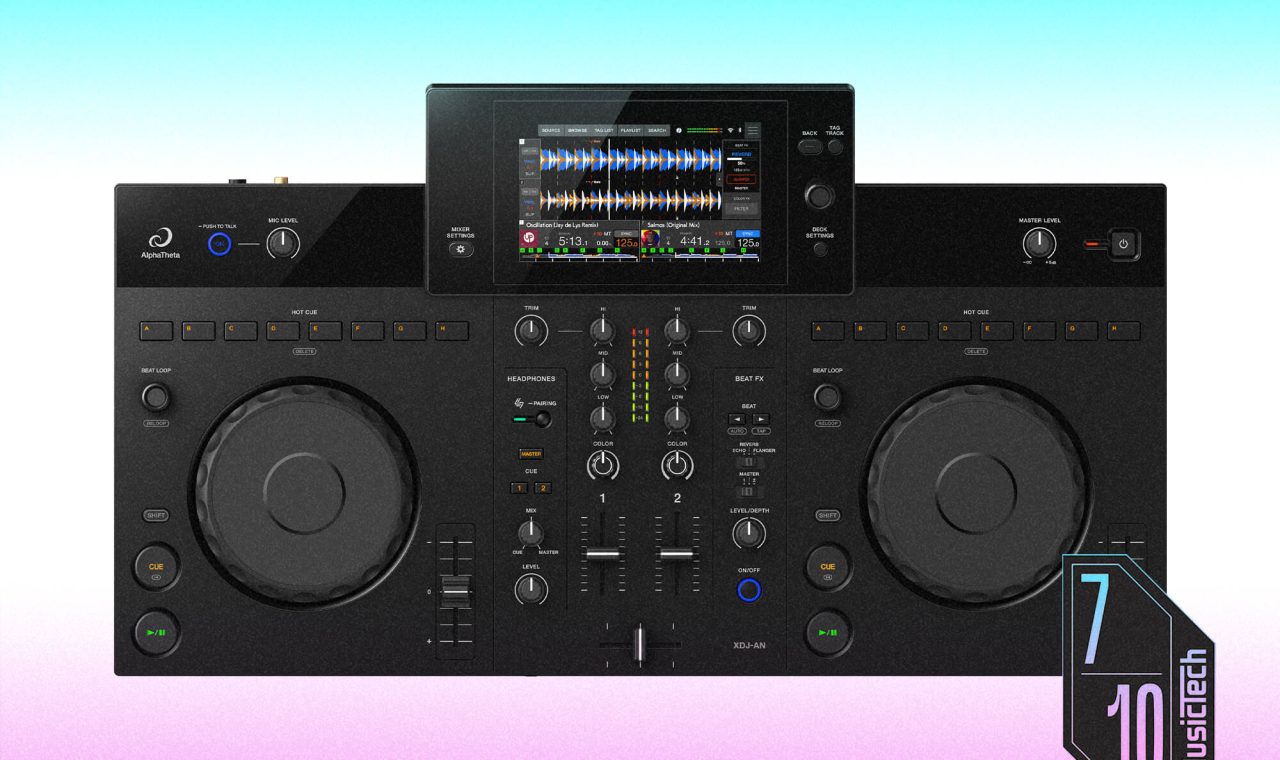
AlphaTheta’s XDJ-AN aims to bridge the gap between a compact XDJ-RR-style player and the laptop-plus-controller setup many DJs use today. Priced around £999 / $1,199 / €1,149, it offers a two-channel standalone rekordbox experience in an ultra-compact chassis, trading many physical controls for a simplified surface and a 7-inch touchscreen.
Design and build
Out of the box the XDJ-AN feels pleasantly weighty and well finished. There’s plenty of plastic, but nothing that feels overtly flimsy, and the capacitive jog wheels are responsive and predictable for the target audience.
That said, AlphaTheta’s pared-back approach leaves noticeable empty panel space. Pitch faders have a shorter throw than expected despite room for longer sliders, and several functions that would traditionally have dedicated buttons have been moved into the small touchscreen.
The control surface is sparse by design: there are no physical buttons to load tracks to deck A or B (track loading is handled via an on-screen pop-up), and features such as Sync, Slip Mode, Quantize and Vinyl Mode require touchscreen interaction. For users who prefer tactile controls this will feel like a significant change.
Connectivity and software
AlphaTheta equips the XDJ-AN with three USB-C ports: one for power (a brick is supplied), one for media storage and one for connecting a computer or mobile device. Placing the media port on the rear panel is a contentious decision — it departs from the usual top-mounted USB location, can be awkward with long keys and makes swapping drives mid-set less convenient.
The unit can be powered from other USB-C sources such as a MacBook charger or powerbank, which helps offset having to carry the supplied power brick. Audio connectivity is straightforward but basic: balanced XLR master output, unbalanced RCA outs and a balanced TRS microphone input. There is no dedicated booth output or auxiliary RCA/3.5 mm input; Bluetooth input and output are provided instead, but Bluetooth input and output cannot be used simultaneously.
Software support covers several ecosystems. With rekordbox the hardware unlocks Performance mode without requiring a subscription, and Link Export lets you browse and play an existing rekordbox library from the unit. Serato users get Serato DJ Lite immediately, while Serato DJ Pro requires an extra licence or subscription. Algoriddim djay Pro is also supported. Mobile connectivity is asymmetric: iOS devices can connect via USB-C, while Android devices are limited to wireless connections and the DJM-REC app remains iOS-exclusive for now.
Performance and workflow
The XDJ-AN leans heavily on touchscreen interaction. Many features once controlled by hardware — microphone EQ, talkover settings and a range of performance functions — live in the 7-inch display. That keeps the surface clean and approachable for newcomers, but at this price point the trade-off feels conspicuous.
Pad behaviour is another example of compromises. The unit adopts the same Hot Cue layout seen on AlphaTheta’s flagship players, but the pads only show a single orange backlight colour, and in standalone mode they support only Hot Cues and Hot Loops. Connecting a computer unlocks additional pad modes tied to software, which makes the hardware more capable when used with a laptop but weakens its standalone positioning.
Effects are pared back: three Beat FX (Echo, Reverb, Flanger) are accessed via a hardware rotary selector and a channel assign switch, while six Sound Colour FX live in the touchscreen and are controlled by dedicated knobs beneath each channel’s EQ. The Beat FX implementation is tactile and usable, but some DJs may miss a broader palette of effects.
One clear weak point is the crossfader. It displays a dead zone of roughly half a centimetre on either side before audio responds, producing a vague feel that makes quick cuts and basic scratch moves difficult to execute. AlphaTheta may address this with firmware, but as shipped the crossfader underperforms expectations.
SonicLink, AlphaTheta’s ultra-low-latency wireless headphone technology, is included alongside the standard 3.5 mm headphone output. It offers genuinely cable- and latency-free monitoring, but compatible headphones are currently positioned above the £300 mark, limiting immediate uptake among buyers.
Who it’s for — and verdict
The XDJ-AN is an interesting play in AlphaTheta’s lineup. It introduces newcomers to a club-style layout and standalone rekordbox workflow in a compact, comparatively affordable package. For users who prioritise simplicity and want a bridge to larger club players, it largely delivers on that promise.
However, the simplification sometimes goes too far. Heavy touchscreen reliance, the rear-mounted USB media port, single-colour pads, missing Key Sync, limited Beat FX, no booth output and a sluggish crossfader mean some DJs may outgrow the unit quickly or prefer a more conventionally equipped controller for the same money.
In short: the XDJ-AN is a capable, approachable standalone system that emphasises accessibility over exhaustive control. For beginners wanting a tidy, club-inspired layout it will hit the mark; for DJs seeking a full set of tactile controls and performance features, it may feel like a compromise.
Key features
- 2-channel standalone DJ system
- Ultra-compact design with 7-inch touchscreen
- 8 Hot Loops, 8 Hot Cue pads (single backlight colour)
- USB-C ports for power, media and computer connection
- Balanced XLR / unbalanced RCA stereo outs, balanced TRS mic in
- 3 Beat FX, 6 Sound Colour FX, SonicLink headphone support
ElectroLouis independently rewrote this report from the cited source material.


