At 206 South Jefferson Street in Chicago’s West Loop there is a three story brick building that used to be a factory. For a few years starting in 1977 it was a nightclub, and the shortened version of that club’s name is now used in every country on earth to describe a style of music. Most people who say the word have no idea it began as an address.
The club was the Warehouse. The music became house.
A DJ from the Bronx
Frankie Knuckles was born Francis Nicholls in the Bronx in 1955. As a teenager he and his friend Larry Levan haunted New York’s early discos, and while Knuckles was studying textile design at the Fashion Institute of Technology, both started working as DJs. Knuckles ended up as the resident at the Continental Baths, a gay bathhouse under the Ansonia Hotel with a pool, steam rooms and a disco, and stayed until it closed in 1976. Levan went on to build the reputation of the Paradise Garage.
In Chicago, Knuckles’s old friend Robert “Robbie” Williams was opening a club for the city’s gay and alternative crowd in a former factory on the west side industrial strip. When it opened in 1977 Williams asked Knuckles to play regularly. Knuckles moved west and became the Warehouse’s resident DJ.
What a night looked like
The Warehouse ran from midnight Saturday to midday Sunday. Admission was five dollars, and juice and water were handed out to dancers at no charge. The crowd was mostly gay Black and Latino men. Accounts of how many came on a given night vary widely: the club’s own history puts it around five hundred, while biographies of Knuckles describe crowds of up to two thousand.
People who went describe it in religious terms. Many of the regulars had grown up in churches where they were not welcome as who they were, and the Warehouse gave them somewhere to be together that was described at the time as “unusually free of aggression.”
Musically it started as a disco and R&B room. Then, in the late 1970s, disco ran into trouble, and Knuckles went looking for ways to keep the music alive for his dancers. His answer was to start making his own versions of the records.
Reel to reel
On the middle floor of the building, Knuckles began editing disco records on a reel to reel tape machine. He stretched intros and breaks, looped the parts that worked hardest on the floor, and laid new rhythm on top of old favorites. He added synthetic handclaps, new hi hat patterns and bass loops. He also mixed disco with European electronic music.
The result was something that was not quite disco anymore. A steady four on the floor kick drum sat at the center, and everything else could be cut, repeated and rearranged around it. A record made for radio became a record rebuilt for a dance floor at five in the morning.
Williams helped name it. On promotional posters he described the events at the Warehouse as “house” parties playing “house” music. At first “house” meant an attitude, music you would hear at that club, rather than a genre. Over time it became the genre.
The sound leaves the building
The Warehouse did not win over the rest of the Chicago club scene right away. That changed as curious straight audiences started showing up and as other DJs began copying what they heard. Wayne Williams, a young DJ from the South Side, took the sound back to his own crowds and helped carry it beyond the gay clubs.
In late 1982 the Warehouse doubled its admission price and, by most accounts, became more commercial. Knuckles left in November 1982 to start his own club, the Power Plant, and later the Powerhouse. His regulars followed him. The Warehouse’s owners responded by opening a new club, the Music Box, and hiring a DJ named Ron Hardy, who would go on to play a central role in the next chapter of Chicago house.
Around 1983 Knuckles bought his first drum machine from a young Detroit DJ named Derrick May, who regularly drove to Chicago to hear Knuckles and Hardy play. Pairing bare drum machine patterns with cult disco records defined the sound of early Chicago house, and by 1985 local producers were trying to recreate it in studios.
One record shows how the process worked. In 1982 Knuckles was handed a reel to reel tape of an unreleased track called “Your Love” by the then unknown Jamie Principle. He played it in his sets for a year before it was ever pressed, and it became a crowd favorite purely through the club. He later re-recorded it with Principle, and in 1987 helped get it and “Baby Wants to Ride” released on vinyl.
After the Warehouse
Knuckles went on to produce and remix for decades. His 1991 album Beyond the Mix included “The Whistle Song,” the first of four number ones on the US dance chart. He remixed Michael Jackson, Luther Vandross, Diana Ross and Toni Braxton, took over as resident at the Sound Factory in Manhattan, and in 1997 received the Grammy for Remixer of the Year, Non Classical. He was often called the godfather of house music.
He died in Chicago on March 31, 2014, at 59, from complications of diabetes.
A street, a holiday and a landmark
Chicago’s relationship with dance music has not always been warm. In 2000 the city passed what became known internationally as its anti rave ordinance, which exposed property owners, promoters and DJs to $10,000 fines for involvement in an unlicensed dance party.
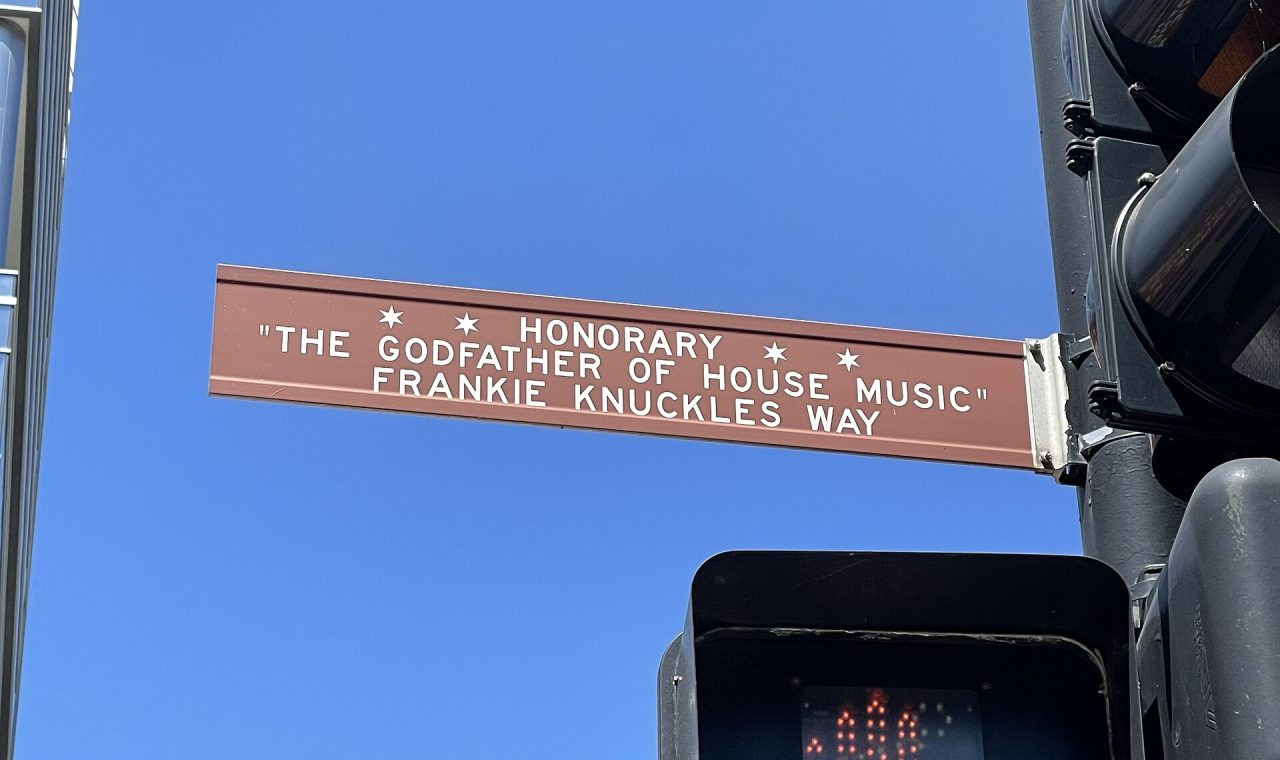
Four years later the same city honored Knuckles. On August 25, 2004, the stretch of Jefferson Street between Jackson Boulevard and Madison Street, where the Warehouse stood, was renamed Frankie Knuckles Way, and August 25 was declared Frankie Knuckles Day. One of the advocates for the change was an Illinois state senator named Barack Obama.
On June 21, 2023, the building at 206 South Jefferson was designated a Chicago Landmark. The factory that once held a few hundred dancers on a Saturday night is now protected for the same reason people still say the word house when they mean a kick drum on every beat.
Photo: Sarah Stierch (Missvain) via Wikimedia Commons, CC BY 4.0