In 1963 the BBC needed a theme for a new Saturday teatime science fiction show about a traveler in time. The Australian composer Ron Grainer wrote the score: a bassline, a melody and a middle section in a brighter key. Turning that score into a recording fell to the BBC Radiophonic Workshop in Maida Vale, London.
There were no commercial synthesizers in that building. There were no multitrack tape machines. What came back was the Doctor Who theme, one of the first television signature tunes created entirely with electronics, and one of the most recognizable pieces of electronic music ever made. The woman who built it, Delia Derbyshire, would not see her name in the show’s credits for half a century.
A mathematician in a sound lab
Derbyshire was born in Coventry in 1937, the daughter of a sheet metal worker. She won a scholarship to study mathematics at Girton College, Cambridge, switched to music, and graduated in 1959 with a degree in mathematics and music. When she asked the university careers office about work in sound and acoustics, she later recalled, they suggested deaf aids or depth sounding. Decca Records told her it did not employ women in its recording studios.
She joined the BBC in 1960 as a trainee assistant studio manager and in 1962 was assigned to the Radiophonic Workshop, a small department set up to make sounds and music for radio and television that no orchestra could play. Over eleven years there she created music and sound for roughly 200 programs.
How you build a theme with no synthesizer
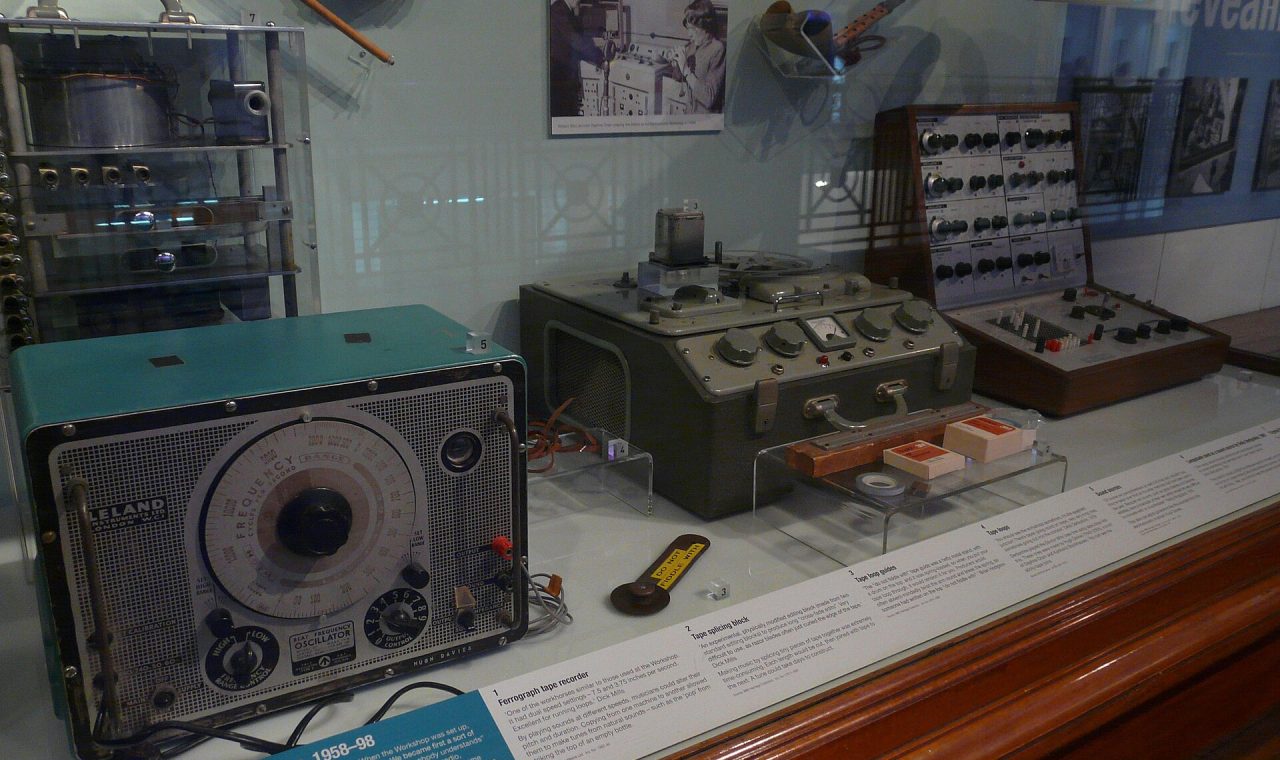
The Workshop’s tools were test equipment and tape. Its oscillators had been designed to calibrate rooms and electronics, not to play music. Derbyshire, assisted by Workshop engineer Dick Mills, built the Doctor Who theme from three kinds of raw material: a recording of a single plucked string, white noise, and the simple waveforms from those oscillators.
The famous pulsing bassline is that one plucked string, recorded, copied and spliced over and over into a pattern. Different notes came from playing the tape back at different speeds. The swooping melody came from adjusting the pitch of banks of oscillators by hand to a carefully timed pattern. The rhythmic hissing sounds, known in the Workshop as “bubbles” and “clouds,” were made by cutting up recordings of filtered white noise.
Every note then had to be cut to length with a blade and stuck to the next one with splicing tape, line by line: the bass, the slides, the hisses, the swoops, the melody, a second high melody line, the bubbles and the clouds. According to accounts of the recording, many of those strips of tape, with an edit roughly every inch, still survive.
Mixing was its own problem. With no multitrack recorder, each finished line was loaded onto a separate tape machine, all of the machines were started at once, and their outputs were combined. If the machines drifted out of sync, the team stopped, trimmed the tapes and tried again. To make the job manageable they built submixes, combining the bass parts into one track, the melody into another, and so on.
“Did I write that?”
The story is told the same way in histories of the show and of the Workshop. When Grainer heard the finished recording, he asked, “Did I write that?” Derbyshire answered, “Most of it.”
Grainer tried to give her a co-composer credit and a share of the royalties. The BBC refused. Workshop staff were supposed to remain anonymous, and the policy held. Derbyshire’s arrangement opened Doctor Who, with small additions and edits, from the first episode in 1963 until 1980. She was not credited on screen until the show’s 50th anniversary special, The Day of the Doctor, in 2013. By then she had been dead for twelve years.
The rest of the work
The theme overshadows everything else she did, which is a shame, because the rest is remarkable. With the playwright Barry Bermange she made the Inventions for Radio for the BBC’s Third Programme in 1964 and 1965, pieces in which ordinary people talk about dreams, God, death and old age over electronic soundscapes. In 1966 she, Workshop colleague Brian Hodgson and synthesizer pioneer Peter Zinovieff formed Unit Delta Plus to promote electronic music. Its appearances included the 1966 Million Volt Light and Sound Rave, the event where the Beatles’ “Carnival of Light” got its only public playing.
In 1968, working with Hodgson and David Vorhaus as White Noise, she helped make An Electric Storm, an album now regarded as an influential early electronic record. She wrote library music under the anagram pseudonym Li De la Russe, which ended up on British children’s science fiction shows, and worked on sound for a Royal Shakespeare Company production of Macbeth.
She left the BBC in 1973 and stopped producing music in 1975. For years afterward she worked jobs that had nothing to do with sound, including as a radio operator on a gas pipeline project and in a bookshop. Near the end of her life she returned briefly, supplying sounds for a short track by Peter Kember released in 2001, the year she died at 64.
Why producers still talk about her
After her death, 267 reels of tape and a box of about a thousand papers were found in her attic. They went first to the composer Mark Ayres, who had already rescued the Workshop’s tape archive, and in 2007 were placed on permanent loan with the University of Manchester, where the digitized tapes and papers can be studied at the John Rylands Library. Artists including Aphex Twin, the Chemical Brothers and Paul Hartnoll of Orbital have named her as an influence, and she is often described as the unsung heroine of British electronic music.
For anyone who makes music on a laptop today, her method is worth sitting with. Every technique a modern producer takes for granted, from pitching a sample up and down to building a bassline from one recorded sound to layering stems into a mix, she did by hand with a razor blade, a stopwatch and machines never meant for music. The tools changed. The ideas are the same ones she was cutting into tape in 1963.
Photo: Loz Pycock via Wikimedia Commons, CC BY-SA 2.0