Hours before doors open at a serious club, someone stands in the middle of an empty dance floor holding a measurement microphone while the speakers hiss. The sound is a steady rush, a little like a waterfall. Nobody dances to it. It is pink noise, and it is the first step in making a room full of loudspeakers sound like one instrument.
Tuning a club system is less about the speakers than about the room they are in. Here is what engineers are actually doing during that quiet hour, and why the same rig can sound clean in one building and like mud in another.
Why a system needs tuning at all
In theory a sound system should reproduce whatever goes into it without adding color or distortion. In practice it never does on its own. Venue size, shape, building materials and even how densely the crowd is packed all change what reaches the listener. A concrete basement, a converted warehouse with a steel roof and a carpeted lounge will each treat the same speaker very differently.
Dance venues make this harder than most. Clubs end up in former warehouses, old theaters, restaurants and basement pubs with bare walls. Dance events land in aircraft hangars and open fields. Some clubs have balconies or L shaped floors, which makes it hard for everyone in the room to hear the same thing.
The oldest method: ears and a playlist
The original way to calibrate a system needs a healthy pair of ears, music the engineer knows well and a graphic equalizer. The engineer plays familiar tracks through the system, listens for frequencies that stick out or rooms that ring, and pulls them back with the EQ. A variation uses good headphones patched into the clean signal before any processing, so the engineer can switch between what the music should sound like and what the room is doing to it.
That listening pass has never gone away. Even when analysis gear is used, many engineers finish with music playing through the system as a final check, because the goal is a room that sounds right, not a graph that looks right.
Pink noise and the analyzer
Digital signal processing moved much of the work from ears to software. The classic tool is a real time analyzer, or RTA. The engineer feeds pink noise into the system and measures the result with a calibrated microphone connected to the analyzer.
Pink noise is chosen for a reason. Each octave of it carries the same amount of energy, whether that octave is the deep bass between 40 and 80 hertz or the treble between 8,000 and 16,000. That roughly matches the way people hear pitch, so a system that measures flat with pink noise is a reasonable starting point. Where the analyzer shows a bump or a hole, the engineer adjusts the EQ.
Measuring time as well as tone
An RTA only tells you how loud each frequency is. Newer dual FFT analysis software, Smaart being the best known example, also shows what is happening in time. It compares the signal going into the system with what the microphone picks up, so the engineer can see delays and phase problems as well as frequency response.
It also means the system can be measured using ordinary music instead of noise. Calibration can keep running during the night, which matters because a full room behaves differently from an empty one.
Keeping speakers in step
Time is the part of tuning most clubgoers never think about. Sound in air travels at about 343 meters per second at 20 degrees Celsius, and a little faster when the air is warmer. That works out to roughly one millisecond for every 34 centimeters. A speaker hanging ten meters from the dancer is delivering its sound almost 30 milliseconds after it left the amplifier.
Now add a second set of speakers. Large or awkward rooms use fill speakers to cover dead spots, under balconies or around corners. If those fills play at the same instant as the main stacks, people near them hear the same kick drum twice, once from the nearby fill and again a moment later from the mains. The result is smeared bass and a hollow, phasey sound.
The fix is a delay. Loudspeaker management processors let the engineer hold back the fill speakers by just enough milliseconds that their sound lines up with the sound arriving from the main system. Done well, the whole room hears one coherent source.
Get it slightly wrong and you create a comb filter. When a sound is added to a delayed copy of itself, some frequencies reinforce each other and others cancel, leaving a response full of evenly spaced peaks and notches. On a graph it looks like the teeth of a comb. To a dancer it sounds like the music has been squeezed through a tube.
Splitting the job
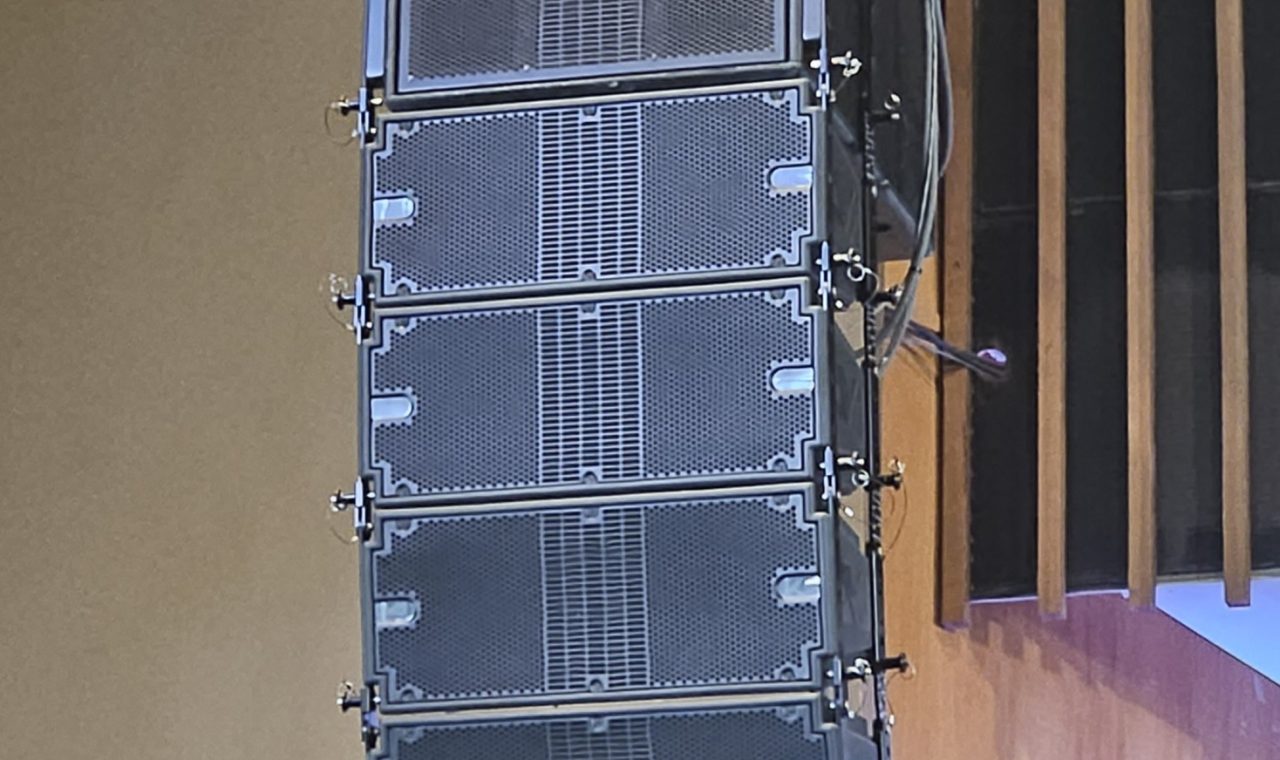
Large systems send the signal through a crossover, which splits it into frequency bands, low, mid and high, each with its own amplifiers and speaker boxes. Getting the crossover points and the level of each band right is part of tuning, and so is lining up the timing between bands so the sub and the top boxes do not fight each other.
Filters help too. A high pass filter removes infrasonic content below what people can hear, which wastes amplifier power and is hard on subwoofer drivers. A low pass filter removes ultrasonic noise that can creep in from radio, lighting control or digital gear.
The bass problem
The hardest part of any club tune lives below about 200 hertz. Most rooms have their fundamental resonances, called room modes, somewhere between 20 and 200 hertz, and each one relates to a dimension of the room. At those frequencies the room itself rings. Stand in one spot and a particular bass note booms. Take three steps and it nearly vanishes.
That is why dance clubs take subwoofers seriously. A folk coffeehouse may run no subwoofers at all. A room built for house and techno, where the kick and bass line are the point of the music, may run several large ones, and their placement relative to the room’s walls matters as much as their size.
Rooms built around the sound
The extreme version is to design the room around the system. When Paradise Garage opened in New York in 1978, it had a sprung dance floor and a custom system developed by Richard Long of Richard Long and Associates. The main room was reportedly laid out around the sound system, which was said to be the best in the city at the time. The DJ and producer François Kevorkian described the place as a “temple of music.”
Most clubs cannot rebuild a room from scratch. They can do the next best thing: measure it, listen to it and adjust until the system and the building stop arguing. The waterfall hiss before doors open is where that starts.
Photo: Epolk via Wikimedia Commons, CC BY-SA 4.0