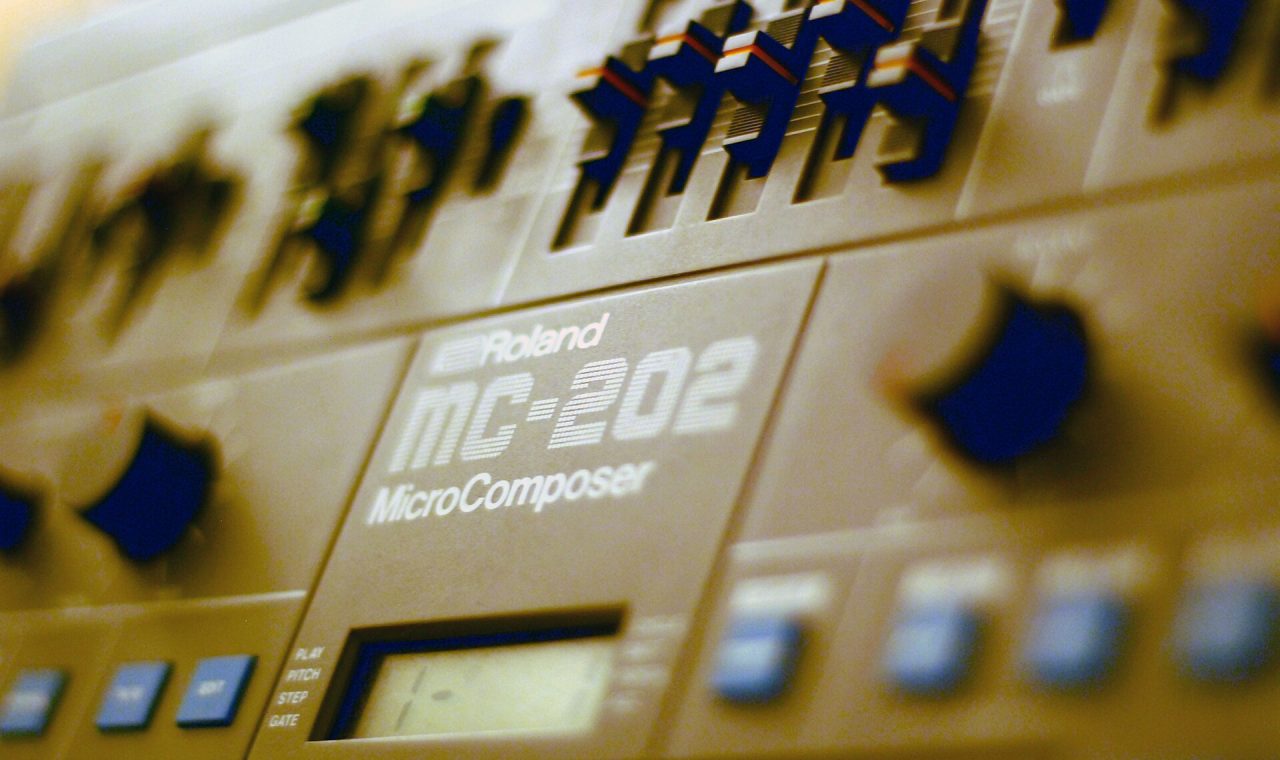
In 1983 Roland released a small silver box that could make a bass line, play it back from memory, drive a second synthesizer at the same time and run on batteries. It was called the MC-202 MicroComposer. It is now often described as the first groovebox.
It also had a habit that would horrify any modern producer. Turn it off, and every note you had programmed was gone.
Two machines in one case
The MC-202 combined two things Roland had been building separately. One was a sequencer, a device that stores notes and plays them back in time. Roland had made expensive digital sequencers before under the MicroComposer name, the MC-8 and the MC-4. The other was a monophonic analog synthesizer.
The synth section is close to Roland’s SH-101, which came out a year earlier. The two share their circuitry almost entirely, along with the same look: similar control layout, casing, lettering, knobs and slider caps. The MC-202 has one voltage controlled oscillator that can produce sawtooth and square or pulse width waves at the same time, plus a sub oscillator an octave below. It runs through a resonant 24 decibel low pass filter, with a single ADSR envelope and an LFO.
Roland did trim a few things. Compared with the SH-101, the MC-202 lacks the noise generator, the choice of LFO shapes and the modulation and pitch bend controls. It added one thing the 101 did not have: a delay on the LFO, so vibrato could fade in after a note starts.
A sequencer with a 303 trick
The sequencer is the real reason the MC-202 matters. It can play two separate sequences at once. One drives the internal synth. Both are available on two sets of CV and Gate jacks on the back, so the unit can control two external analog synths, or one external synth alongside its own voice.
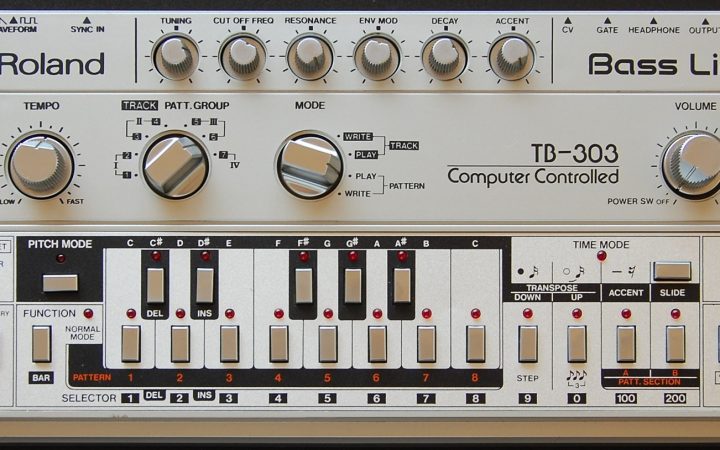
Notes are entered the way Roland’s older MicroComposers worked, with pitch, length and gate length typed in step by step. The sequencer holds up to 2,729 notes, according to the Vintage Synth Explorer database. Each note can also carry an accent and a slide, the same two settings that made Roland’s TB-303 bass machine famous. That is what allows the MC-202 to produce acid style lines, and it is something the SH-101 cannot do, because the 101 has no way to program accents.
The MC-202 also had DIN sync, the clock standard Roland used before MIDI, with inputs and outputs that let it run as master or slave alongside a TR-808 or a TB-303. It can also generate and follow FSK sync tones recorded on tape, a common way to lock early electronic gear to a multitrack recorder.
The memory problem
Here is the catch. The sequence memory is volatile. When the power goes off, the patterns disappear. Roland’s answer was a tape interface. Owners recorded their sequences as audio onto a cassette, then played the tape back into the machine to reload them.
Portability was a selling point. The unit can run on an external power supply or on six C batteries, and one fan page linked from its Wikipedia article celebrates exactly that: “Portable Fun With Only 6 C Batteries!”
The poor man’s 303
The MC-202 lived in the shadow of its siblings. Vintage Synth Explorer describes it as sounding very much like the TB-303 and the SH-101, and notes it was sometimes called “the poor man’s 303.” The same database says programming it is “a bit too intense and over done for the simple monophonic bass line,” which is a polite way of saying the step entry was a chore.
Many owners worked around that. The two CV and Gate outputs and the DIN sync jacks made it a useful hub for an older analog studio, able to receive sync on one port and send it on two. Others hooked up a MIDI to CV converter and played the synth section from a keyboard, which effectively turns it into an SH-101 with a slightly different feature set.
In 1997 a company called Defective Records Software released MC-202 Hack, a program that writes sequences on a computer and sends them to the MC-202 as audio through its cassette input. It could convert MIDI files into MC-202 patterns. A second version in 2009 worked the other way too, pulling sequences off the machine and saving them as MIDI.
Who used it
Despite the nickname, the MC-202 found its way into a lot of serious studios. Vintage Synth Explorer lists Autechre, Future Sound of London, Coldcut, the Human League, Underworld, Aphex Twin, LFO and Plastikman among its users, along with Astral Projection, Sabres of Paradise, Freddy Fresh and Jimmy Edgar. Future Music magazine devoted a feature to it in its November 1998 issue.
Was it really the first?
The word groovebox did not exist in 1983. Roland coined it in 1996 for the MC-303, a digital box that combined a sound module, an eight track sequencer and controls meant for improvising while the music played. The MC-303 shipped with drum kits modeled on Roland’s own TR-808 and TR-909, and it is usually described as the MC-202’s digital successor, despite borrowing its number from the 303.
The MC-303 was aimed at house DJs and home musicians rather than professional producers. Some in electronic music derided it at first, worried that cheap all in one boxes would lower standards. Today that kind of instrument is widely accepted, and Roland’s MC line has continued all the way to the MC-707 and MC-101 in 2019.
Whether the MC-202 was truly first depends on your definition. A groovebox, in the usual sense, is a sound source, a sequencer and a hands on control surface in one unit, built for loop based music. By that measure, the idea goes back at least to the Movement Computer Systems Drum Computer in 1981 and the Fairlight CMI’s Page R pattern sequencer in 1982. What the MC-202 did was put the concept in a small, battery powered analog box that was cheap enough for ordinary musicians.
That is the real legacy. Every all in one beat machine on a producer’s desk today, from Roland’s own MC line to the boxes that copied it, owes something to a silver sequencer that forgot its patterns every time you pulled the plug.
Photo: Brandon Daniel via Wikimedia Commons, CC BY-SA 2.0