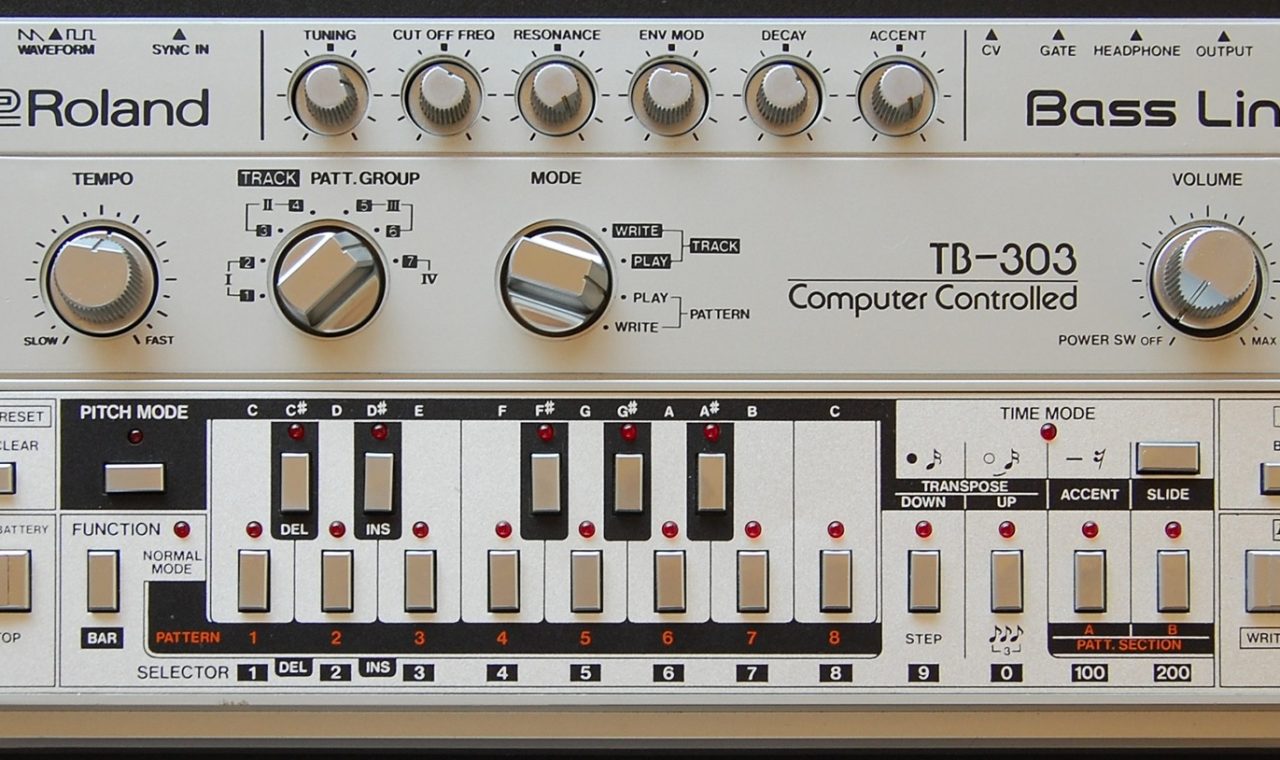
In 1981 Roland released a small silver box called the TB-303 Bass Line and marketed it as a “computerised bass machine.” The pitch was that a musician could program a bass part into it instead of hiring a bass player. It cost $395 in the US.
Bass players were not replaced. Musicians found the sound unconvincing, the machine was hard to program, and Roland discontinued it in 1984. Then a few young producers in Chicago got hold of cheap used ones, turned the knobs in a way nobody at Roland had planned for, and the sound they found ended up on dance floors from Chicago to the fields outside London.
A bass guitar that never sounded like one
The 303 was designed by Tadao Kikumoto, the same Roland engineer behind the TR-909 drum machine. Inside, it is a simple synthesizer. It produces either a sawtooth wave or a square wave, and that signal goes through a 24 decibel per octave low pass filter shaped by an envelope generator. Notes are entered into a built in sequencer, along with two extra settings for each step: accent, which makes a note louder and brighter, and slide, which glides the pitch into the next note.
Programming it was famously awkward, and Roland did not help. In the US the company did not supply an English language instruction manual, so many owners had to work out the sequencer on their own. The sound itself was thin and synthetic next to a real bass guitar, which was the one thing its target buyers wanted it to imitate.
Not everyone ignored it. The Indian musician Charanjit Singh used a 303 alongside a TR-808 on his 1982 album Synthesizing: Ten Ragas to a Disco Beat. The Bollywood producer Bappi Lahiri used it on several film songs in 1983. That same year, “Rip It Up” by the Scottish band Orange Juice became the first song featuring the 303 to reach the top ten of the UK singles chart. Singh’s album sold poorly and was largely forgotten until it was reissued around 2010, when critics noticed how much it sounded like music that would not exist for another five years.
Turning the wrong knobs
In the mid 1980s three friends in Chicago, Earl “Spanky” Smith Jr., Nathaniel Pierre Jones, known as DJ Pierre, and Herbert “Herb J” Jackson, were working together as a group called Phuture. They bought a cheap secondhand 303 and started experimenting.
Instead of programming a bass line and leaving it alone, they changed the settings while the pattern played. The technique that became the signature is to lower the filter cutoff and push the resonance high, then sweep those controls by hand while the accents and slides in the sequence push notes up and down an octave. The result is a squelching, rubbery, almost liquid line that seems to change shape on every bar even though the notes are the same.
Phuture recorded a twelve minute track built around that sound to tape. Ron Hardy, the resident DJ at the Music Box, the club the Warehouse’s owners opened after Frankie Knuckles left, started playing it, possibly as early as 1985. The crowd did not take to it right away. According to accounts of the period, Hardy once played it four times over the course of a single night until the dancers came around.
Regulars at the Music Box started calling it “Ron Hardy’s Acid Track.” When Trax Records released it in 1987, the title was “Acid Tracks.” Sources disagree on whether Phuture or label owner Larry Sherman picked the name, and on what exactly “acid” was meant to refer to. It is often credited as the first acid house record.
From Chicago to Britain
The timing at home was bad. Chicago police cracked down on parties and events, and by 1988 house records were selling less than a tenth of what they had at the style’s peak. Britain was another story.
The club Shoom opened in London in November 1987, run by Danny Rampling and his wife Jenny, and was one of the first places to bring acid house to British clubbers. The period that followed is often called the Second Summer of Love. In November 1988 “Stakker Humanoid,” produced by Brian Dougans, who later formed Future Sound of London, reached number 17 on the UK chart and put an acid track on Top of the Pops.
Louder and dirtier
As acid evolved, producers stopped treating the 303 gently. Through the late 1980s and early 1990s it was often overdriven for a harsher edge, as on Hardfloor’s 1992 EP “Acperience.” In 1995 a distorted, processed 303 drove Josh Wink’s hit “Higher State of Consciousness” and Daft Punk’s “Da Funk.”
Fatboy Slim liked how simple the controls were and named his first single “Everybody Needs a 303” in 1996. In 2011 The Guardian listed the release of the 303 as one of the 50 key events in the history of dance music.
What a failure costs now
The machine that buyers ignored at $395 became one of the most sought after instruments on the used market. As acid caught on, prices for original units climbed sharply, and as of 2014 they were selling for more than £1,200.
That demand created a whole industry of imitations. Software emulations appeared, then hardware clones. Roland itself came back to the design with the TB-3 Touch Bassline in 2014 and the smaller TB-03 in 2017, which added an LED display plus delay and overdrive effects. Behringer released its TD-3 clone in 2019.
Why it worked
The 303 is a good example of a pattern that keeps showing up in electronic music. A machine is built to imitate something real, fails at that, and becomes cheap. Then people who have no interest in imitation discover what it does that nothing else does.
Kikumoto’s design was meant to be a polite substitute for a bass player. Its filter, its accent and slide, and the fact that someone could twist the knobs while it played turned out to be something else entirely. Phuture did not fix the 303. They just stopped asking it to be a bass guitar.
Photo: Steve Sims via Wikimedia Commons, CC0