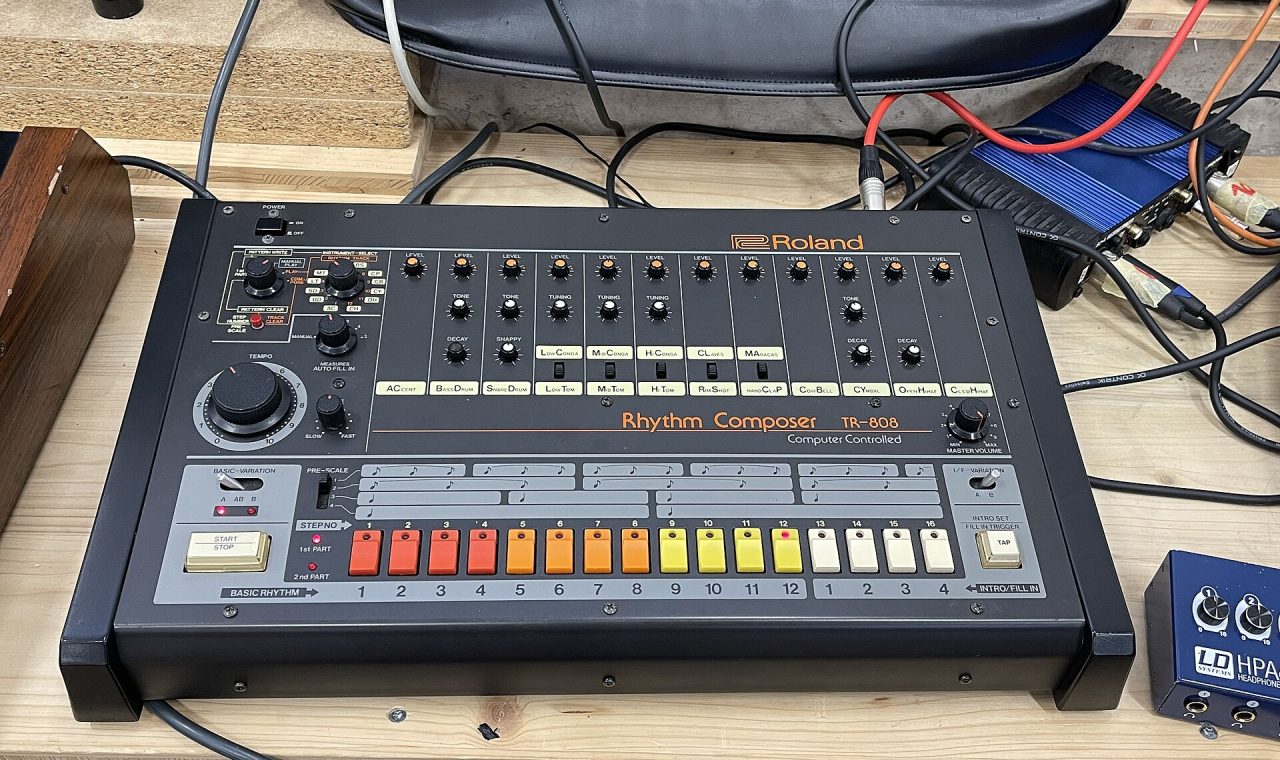
In 1980 Roland put a new drum machine on sale for $1,195 and promised professional musicians a cheaper way to sketch out a song. Three years later the company stopped making it. Fewer than 12,000 had been built. By most of the measures a manufacturer cares about, the TR-808 Rhythm Composer was a failure.
Today it is hard to go a single evening without hearing it. The 808 has been used on more hit records than any other drum machine, and DJ Mag wrote in 2019 that it was probably the most used drum machine of the previous 40 years. The story of how a box that lost the market ended up owning the sound of hip hop, house, techno and modern pop comes down to one stubborn design decision and one part that Roland could not get anymore.
Built to be realistic, and it wasn’t
Roland’s founder, Ikutaro Kakehashi, had been building rhythm machines since the early 1970s. Most drum boxes of that era were add ons for home organs. They played preset patterns with names like bossa nova and waltz, and the player could not program anything. Roland’s CR-78 in 1978 let users write and save their own beats. The 808 was meant to go further and serve working musicians.
The obvious way to do that was samples, short digital recordings of real drums. That was the approach of the Linn LM-1, the rival machine that cost several times as much. Memory chips were expensive, so Roland’s chief engineer on the project, Tadao Kikumoto, proposed something different: a drum synthesizer that would build every sound from analog circuits. A sine wave run through a filter and an amplifier became the bass drum. Bursts of white noise became snares, hats and cymbals.
The result did not sound like a drum kit. Reviewers and musicians at the time described the sounds as clicky, robotic and toy like. One British writer called the cowbell “clumsy, clonky and hopelessly underpitched.” Producers who wanted a machine to stand in for a session drummer bought the Linn instead.
The part Roland could not replace
There is a detail in the 808’s history that sounds like a myth but is repeated in histories of the machine: Kakehashi deliberately bought transistors that had failed quality control. The flaw in those parts produced a noisy, sizzling character that the engineers liked and built into the circuits for the cymbals and hats.
That choice came back to end the machine. As semiconductor manufacturing improved, defective transistors of that specific kind stopped being available. Roland could not restock them, and in 1983 production ended. The company moved on to the TR-909, which mixed analog voices with sampled cymbals.
So the 808 was discontinued partly because the industry got better at making the exact component that gave it its voice.
Why failing helped
Once Roland stopped making it, the 808 became cheap. Used units became common in shops and classified ads, often selling for less than $100. For a teenager in the Bronx, Detroit or Miami who wanted to make records without a band or a studio budget, that price changed everything.
The machine was also easy to use. It was one of the first drum machines that let someone program a full track from start to finish, with breaks and fills, using a row of step buttons. It stored 32 patterns, had a volume knob for every voice, and could sync to other gear. You did not need to read music. You needed to press buttons in time.
Early adopters had already shown what it could do. Yellow Magic Orchestra used an 808 that Roland rented to them before release, at a 1980 concert at the Budokan in Tokyo. The band’s Ryuichi Sakamoto used it on his album B-2 Unit the same year, including the track “Riot in Lagos,” which reached club DJs. In 1982 two records pushed the machine into the mainstream in very different ways. Marvin Gaye’s “Sexual Healing” became the first hit single in the United States to feature it. Afrika Bambaataa and the Soulsonic Force released “Planet Rock,” a record built on 808 percussion that shaped electro, Miami bass and the early Detroit techno sound.
The kick that became a bassline
The 808 bass drum is the sound most people mean when they say “808.” Its decay control lets the kick ring out for a long time, and as it rings the pitch sinks slightly, producing a low boom that rattles car trunks. Producers found they could tune that long kick to different notes and play it as a bassline. Rick Rubin is often credited with popularizing the trick in the 1980s hip hop records he produced.
That is the root of a sound that runs from Run DMC and Public Enemy through Southern hip hop and into trap, where a pitched, distorted 808 is often the loudest thing in the mix. Hank Shocklee of the Bomb Squad put it plainly: “it’s not hip-hop without that sound.” Kanye West named a whole album after the machine, 808s & Heartbreak, in 2008.
On the dance floor the 808 went another way. In the United Kingdom the band 808 State took their name from it, and the machine became a fixture of acid house and rave. Its handclap and cowbell turn up across house records. In pop it is everywhere from Whitney Houston’s “I Wanna Dance With Somebody” to the heartbeat kicks that producers still reach for.
Still in production, in a way
Roland never brought the original back, but the sound never left. Samples of the 808 ship with almost every piece of music software. Roland released its own recreations, including the TR-08 in 2017 and software versions in 2018, and other manufacturers have built analog clones. In 2025 Roland introduced the TR-1000, its first drum machine in four decades to use analog synthesis, with analog versions of the 808 voices.
An original unit now sells for many times its 1980 list price. The machines that did not sell are the ones that changed music, because they ended up cheap and in the hands of people nobody at Roland was designing for.
If there is a lesson for producers in all this, it is that “realistic” is not the same as “good.” The 808 lost to a machine that sounded like real drums. It won because it sounded like nothing else, and because the people who picked it up treated its quirks as the whole point.
Photo: 1904.CC via Wikimedia Commons, CC BY 4.0