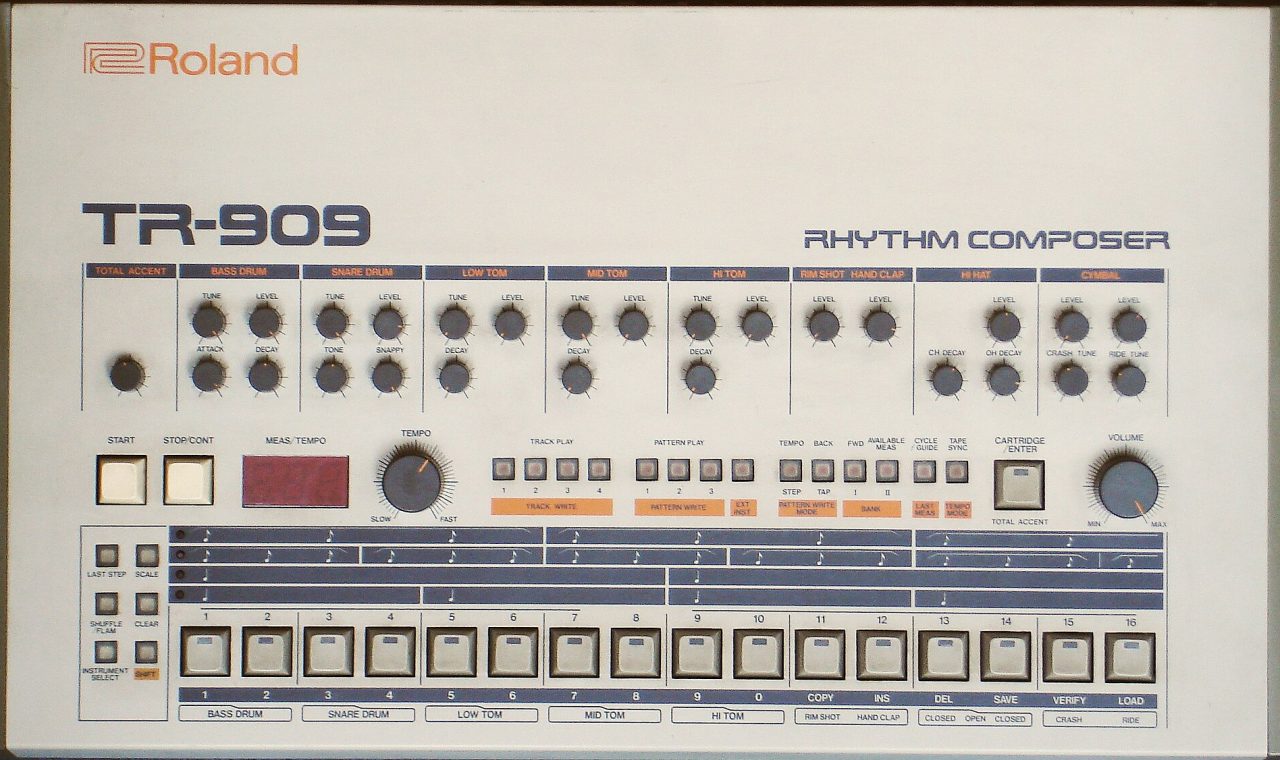
In 1983 Roland put a new drum machine on sale for $1,195. It could talk to other instruments over a brand new standard called MIDI, it had a sequencer that could hold a whole song, and some of its sounds were digital recordings of real cymbals. On paper it was the most modern rhythm box the company had ever built.
A year later Roland stopped making it. About 10,000 units had left the factory. The TR-909 Rhythm Composer had flopped, and the reason it flopped is the same reason you can still hear it in almost any club on a Saturday night.
Half real, half synthetic
The 909 was designed by Tadao Kikumoto, the engineer who had led work on Roland’s TR-808 and who also designed the TB-303 bass synthesizer. Makoto Muroi was a chief engineer on the project. Atsushi Hoshiai wrote the software, and Yoshiro Oue built the voice circuits.
By the early 1980s the market was moving toward samples, short digital recordings of real drums played back on demand. Rival machines like the LinnDrum used them for everything. Roland went halfway. According to a company representative quoted in later histories of the machine, the engineers felt samples had drawbacks, so they used a mix: sampled cymbals and hi hats, and analog synthesis for everything else.
The cymbals have a story of their own. Hoshiai recorded his own kit for them, a pair of Paiste and Zildjian hi hats and a Paiste crash that served for both the crash and the ride. He did it in the Roland office after the staff had gone home, so the room’s natural reverb would be part of the sound. He sampled them at 6 bits, a very coarse resolution even then, and edited the waveforms on a CP/M computer. No equalization or compression was added. That coarse recording is the top end people still reach for when they want a track to sound like classic house or techno.
What is actually inside
The 909 has 11 percussion voices: bass drum, snare, low, mid and high toms, rimshot, clap, crash, ride, and open and closed hi hat. It dropped the clave, cowbell, maracas and congas that the 808 had carried. The bass drum has its own attack and decay controls. The snare has a tone knob and a “snappy” knob that sets how much snare wire you hear.
One quirk turned into a feature. The clap and the snare draw on the same noise source, so when both play at once they produce a phasing effect. Producers who programmed claps on top of snares were hearing a circuit sharing its resources, not a deliberate design choice.
The sequencer could chain up to 96 patterns into songs as long as 896 measures, with shuffle, flam and accents on individual steps. The 909 was also the first Roland drum machine with MIDI, so it could sync with other gear or be played from an external controller. A DIN sync port kept it compatible with older Roland boxes like the 808 and the 303.
Why buyers passed
The reviews were not bad. Electronics and Music Maker found it easier to use than the 808 and said it had the best analog drum sounds on the market. The British magazine One Two Testing called it “gloriously easy to use” but also wrote that it “still sounds like a drum machine, instead of a machine playing drums” and lacked “the authenticity of real sounds for studio work.”
That second review explains the sales. The people Roland was selling to, studio musicians and songwriters, wanted something that could pass for a drummer. The fully sampled competition did that better. Roland ended production after roughly a year and replaced the 909 in 1984 with the TR-707, which used samples for every sound.
The second life
When a machine fails, it gets cheap. By the late 1980s, used 909s were turning up in the hands of young producers in Chicago and Detroit who had no interest in sounding like a session drummer. Derrick May, Frankie Knuckles and Jeff Mills all bought secondhand units. The Chicago producer DJ Sneak later said “every Chicago producer” used one.
What they wanted was exactly what the 1983 reviewers had complained about. Where the 808 is known for a boomy bass drum, the 909 is usually described as aggressive and punchy, and its kick can be reshaped live with the attack and decay knobs. Played loud through a club system, it did not need to sound like a person. It needed to move a room.
Jeff Mills took it furthest. Mixmag called him the “master” of the 909, and MusicRadar described his performance in the documentary Exhibitionist 2 as “one of the most impressive solo drum machine performances ever put to tape.” Mills has said the design let him “play” the machine rather than just program it, using the tuning knobs live to mimic the feel of a drummer.
The 808 had become the backbone of hip hop. The 909, often paired with the 303, did the same job for house, techno and acid. Gordon Reid, writing for Sound on Sound, summed it up: “Like the TR-808 before it, nobody could have predicted the reverence in which the 909 would eventually come to be held.”
Far beyond the club
The 909 never stayed in one genre. In 1984 it appeared on Hiroshi Sato’s city pop album Sailing Blaster, on Haruomi Hosono’s electronic album S-F-X, and on the Skinny Puppy EP Remission. Kurtis Mantronik used it with his hip hop group Mantronix, and it shows up on records by Boogie Down Productions, Ultramagnetic MCs and Public Enemy.
In the 1990s the composer Yuzo Koshiro sampled 909 sounds for the Streets of Rage video game soundtracks. Daft Punk named a track after it, “Revolution 909,” on their 1997 album Homework. Mark Bell used it for the marching percussion on Björk’s “Hunter.” Radiohead put it on “Videotape” from In Rainbows in 2007. Madonna, Pet Shop Boys and Phil Collins used it too.
Fans now mark September 9 as 909 day. In 2017 Roland released the TR-09, a smaller version with extra features, more than three decades after the company had given up on the original.
The engineer who kept his cymbals
Hoshiai has said he is proud that the 909 helped create new kinds of music, something he never expected when he was recording cymbals in an empty office. As of 2024 he was still playing those same cymbals in his jazz band.
There is a lesson in that for anyone shopping for gear. The 909 failed at the job it was designed for and excelled at a job nobody had imagined yet. The reviewers were right that it sounded like a machine. They just could not see that a generation of producers was about to want exactly that.
Photo: 909 bd via Wikimedia Commons, CC BY-SA 3.0