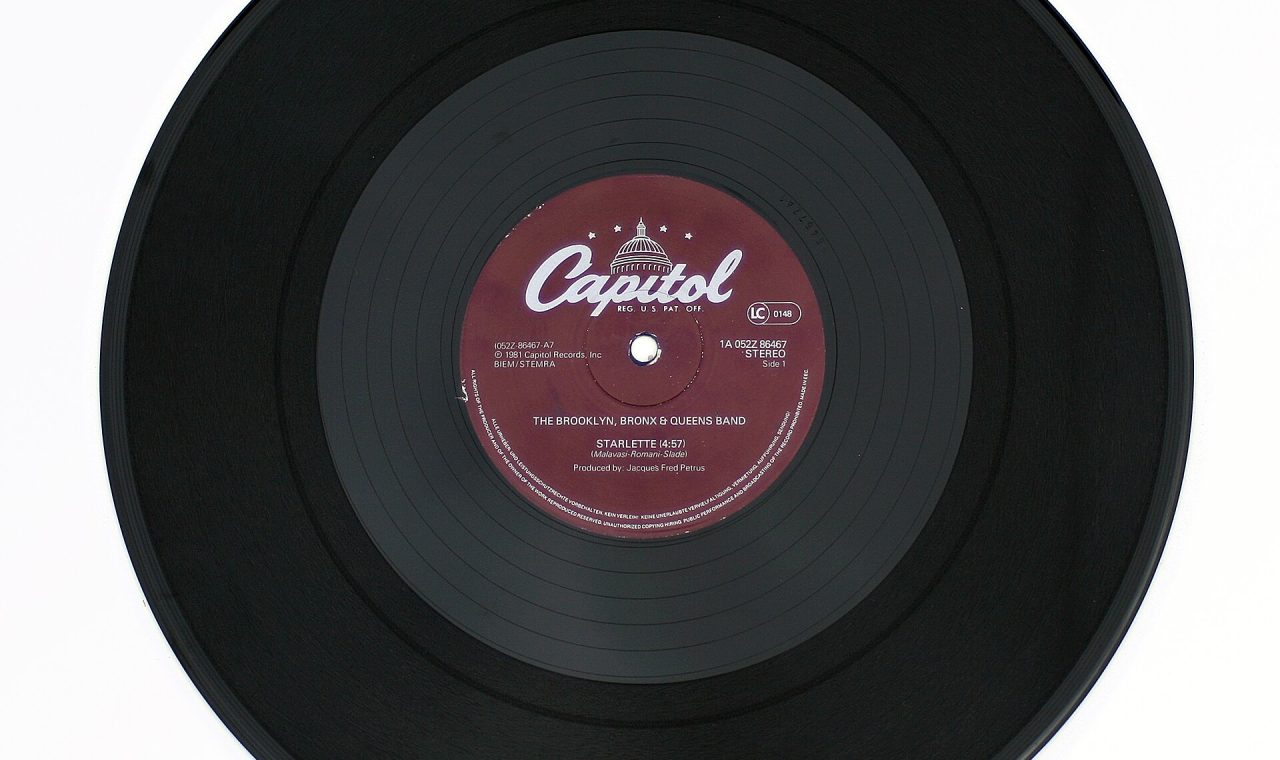
Pick up a dance record from almost any era since the late 1970s and it is the same size as an album: twelve inches across, with a short run of grooves and a lot of shiny blank vinyl near the label. It looks wasteful. It is actually the whole point, and it began with a studio that could not find the right size disc before a Friday night.
The problem with seven inches
Before the 1970s, singles meant seven inch records at 45 rpm. A seven inch side holds about three or four minutes of music at full volume. Twelve inch discs existed, but they were for albums, and an LP gets its long playing time by packing the grooves closely together and giving up some volume.
That arrangement suited radio. It did not suit the DJs in New York’s early discos, who wanted dance records to last longer and hit harder. Two developments at Scepter Records started to change things.
In 1973 Scepter put the instrumental backing track on the flip side of the Ultra High Frequency single “We’re on the Right Track.” With a vocal copy on one turntable and an instrumental on the other, a DJ could switch back and forth and stretch the song out for dancers. Few turntables of the time had variable speed, so blending a track with its own instrumental, which shared the exact same tempo, was a practical trick. Scepter started adding instrumental sides regularly, and other labels followed.
The second development came from a former model and record promotion man named Tom Moulton.
The man who stretched songs
Moulton, born in Schenectady, New York, in 1940, had worked in record shops and in sales and promotion at King, RCA and United Artists before quitting the business. He came back to music in the late 1960s through a homemade tape of overlapping songs he made for a Fire Island bar and restaurant called the Sandpiper.
In early 1974 he went to record labels looking for material he could extend beyond the radio friendly three minute mark. At Scepter, executive Mel Cheren gave him a spare master tape of a so so single by Don Downing called “Dream World.” When Moulton brought it back a few days later, Cheren later wrote, “We were amazed: a so-so record was suddenly snappy, upbeat, and ten times better.” Moulton had nearly doubled its length and, in the process, introduced what became known as the disco break. In December 1974 Billboard gave Scepter a Trendsetter of the Year award for being the first label to make specialized mixes for discotheques.
In January 1975 he went further. For the A side of Gloria Gaynor’s album Never Can Say Goodbye on MGM, he blended “Honey Bee,” “Never Can Say Goodbye” and “Reach Out, I’ll Be There” into one uninterrupted side lasting more than 18 minutes. It is often described as the first DJ mix committed to vinyl, and Moulton has said it was conceived as a tool for dance floors.
The missing seven inch blank
The format itself came from an accident. In 1974 the mastering engineer José Rodríguez needed a test copy of a Moulton remix, “I’ll Be Holding On” by Al Downing, in time for a Friday night. There were no seven inch acetate blanks to be found, so he cut it on a ten inch blank instead.
Moulton looked at the result, a large disc with only a couple of inches of grooves on it, and felt silly about all the wasted space. He asked Rodríguez to recut it so the grooves were spread out across the disc and ran to the normal center. Rodríguez told him that to make that work, the level would have to go up considerably.
Wider groove spacing allows wider groove movement, and that means two things: a louder cut and more dynamic range, the difference between quiet and loud. The bass in particular can swing further. The two men immediately heard a hotter sound that suited club play. Ten inch and then twelve inch acetates of Moulton’s mixes began circulating among DJs, often in tiny runs with plain white labels or handwritten text. The advantage holds up: with only one track or a few per side, a twelve inch single can be cut louder than an album. It can play at 33 or 45 rpm, and 45 gives better treble.
From promo to product
For a while these big discs were promotional tools. In June 1975 Scepter announced it would start sending “12-inch 45s” to DJs through record pools, which had begun in New York that same month to get pre release records into the hands of working DJs. Atlantic became the first major label to send twelve inch promos to DJs that July. Frankie Valli’s “Swearin’ to God,” issued by Private Stock in June 1975 with a running time over ten minutes, was in Moulton’s account the first wide scale promotional twelve inch single.
Labels still did not believe the public would buy them. An extended remix was seen as a way to sell the seven inch or the album, not a product in its own right. The format was also expensive; one label reported that pressing a twelve inch single cost more than pressing an album.
Record shops pushed back. Disco customers kept asking for the club versions, and some old promotional twelve inch copies were changing hands on the resale market for the price of a full album.
Ten Percent
The first disco era twelve inch single sold to the public was “Ten Percent” by Double Exposure on Salsoul Records, in mid May 1976. Label co-owner Ken Cayre decided to release the remix by Walter Gibbons for dancers who heard it in clubs and were not satisfied with the shorter versions on sale. The seven inch edit had come out a month earlier and was selling slowly.
The twelve inch did not include the 3 minute single edit or the album version. Side A carried Gibbons’s mix at 9 minutes 43 seconds. Side B carried a 7 minute 31 second mix by Cayre himself. Sales took off within weeks, and Salsoul picked up Billboard awards at the 1976 Disco Forum. Other labels followed that summer, including Scepter’s Wand imprint, CTI with George Benson and Salsoul again with Moment of Truth.
Why it lasted
The format spread quickly. Jamaican labels began pressing reggae “discomixes” on twelve inch from 1977, with the Jayes’ “Truly” on Channel One often cited as the first. British and French labels adopted it too. When house and techno producers in Chicago and Detroit started releasing records in the 1980s, the twelve inch was their natural home, and groups like Phuture released most of their work that way.
Moulton went on to mix records for MFSB, the Trammps and Andrea True and to produce Grace Jones’s first three albums. In 2004 he was inducted into the Dance Music Hall of Fame. The empty vinyl near the label of a dance single is his legacy too, a reminder of the night someone decided the grooves should spread out and the needle could swing a little wider.
Photo: Ramon Vasconcellos via Wikimedia Commons, CC BY-SA 2.5